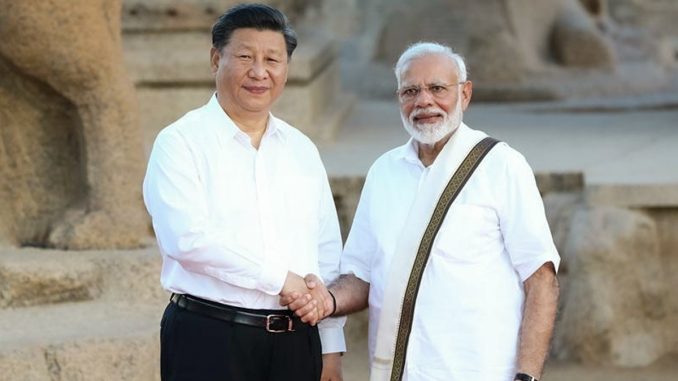
Should Australia’s leaders be reading far more closely the implications for broader Asia that arise from the China-India border dispute détente? Marcus Reubenstein with his opinion on the coooling of relations between the world’s two most populous nations?
Diplomacy is simply the pursuit of national interests; 19th century Prussian general and military theorist, Carl von Clausewitz coined the term: “War is the continuation of policy with other means.” China and India have decided diplomacy is the vastly better solution to their border impasse than war.
In 2020 there was a deadly clash between border patrols resulting in the death of 20 Indian and four Chinese troops. The wider conflict extends back to the brief Sino-Indian war that lasted for one month from October to November in 1962.
Coming on the eve of the BRICS Summit in Kazan, Russia, the timing of this rapprochement was no accident.
Xi Jinping and Narendra Modie met on the sidelines of the summit, their first formal bilateral dialogue in five years. Their meeting came two days after the announcement of an agreement for troops to disengage from locations along their disputed frontier.
The deal allows the two armies to restart patrolling their sides of the border according to an agreed schedule. It also represents a re-set in diplomatic relations and economic cooperation.
In terms of the combined GDP of its members, BRICS has now overtaken the G7 as the most economically significant economic grouping in the world. That said, the G7, which started out in 1973 as the “Group of Five”, is very much more a political than economic alliance.
The original members were the U.S., Britain, West Germany, France and Japan—those victorious in World War Two and the two belligerents, thanks mainly to the Marshall Plan, that received billions of American dollars to rebuild. Italy and Canada later joined to make it the G7.
The G7 now exists to maintain the post-WWII status quo, and essentially prop up the declining U.S. as a global hegemon. BRICS is about economic cooperation, but it’s also about answering a question for those outside, and on the fringes of, the orbit of the U.S. In pursuing their national interests, who do they trust more: China or America?
Through BRICS, China has integrated the five original members, Brazil, Russia, India, China and South Africa, both economically and geopolitically. These nations would never gain admission to the G7, though Russia was in an expanded G8 until its expulsion in 2014.
Now Egypt, Ethiopia, Iran and the United Arab Emirates have joined BRICS, with Saudi Arabia still considering an invitation to join. Another 22 nations, a number of which have histories of conflicts, have applied.
BRICS builds wall for India, while the Quad is just a hedge
In 2021 Australia’s right-wing conservative politicians, and the pro-U.S. hawks in the Labor Party, trumpeted the elevation of the Quad alliance (Australia, India, Japan, U.S.) to leadership status (i.e., heads of government). After just four summits three of the original four leaders were gone, perhaps ironically the only one in still in power was India’s Narendra Modi.
At one level, of the original leaders, Trump and Morrison were playing to a domestic audience blaming China for covid and building it up as a military threat. Sino-Japanese tensions have always simmered since World War Two—Japan’s atrocities against the Chinese, and most other Asian nations, were in many cases far worse than the atrocities of the Nazis in Europe. Aside from sitting in America’s pocket, Japan hosts U.S. troops and nuclear weapons pointed at China and North Korea.
It was in India’s national interest to curb China’s security projection in the Pacific and Indian oceans, however, it is very doubtful that Modi’s end game was supporting any war predicated on a Chinese invasion of Taiwan.
From Australia’s perspective, India hedging its bets with the Quad while maintaining its BRICS membership is a reflection of the fact that our leaders, of both political parties, are totally incurious about the Asian region, and the cultures and histories of its peoples. China is not an expansionist state and India knows it. Asian nations are very adept at playing both sides of the geopolitical street and our leaders generally don’t know it.
As Xi Jinping and Narendra Modi met in Russia, China’s foreign minister released a statement saying, “It is in the fundamental interest of our two countries and two peoples to keep to the trend of history and the right direction of bilateral relations.”
India’s foreign ministry announced, “The two leaders affirmed that stable, predictable, and amicable bilateral relations between India and China, as two neighbors and the two largest nations on earth, will have a positive impact on regional and global peace and prosperity.”
Ergo, constructive diplomacy and economic cooperation beats saber rattling and war.
Main Image: Chinese President Xi Jinping meets with Indian Prime Minister Narendra Modi in the southern Indian city of Chennai, Oct. 11, 2019. (Xinhua)