Despite worrying signs that COVID-19 infections are on the rise in developing economies the major share markets all had a week of solid gains
11 October 2020 | Shane Oliver, AMP Capital (Image: Camila Perez)
Share markets rose solidly over the past week on hopes for a stimulus deal in the US, whether before the election or after if there is a Democrat clean sweep. US shares gained 3.8% over the week, Eurozone shares rose 2.8%, Japanese shares rose 2.6% and Chinese shares gained 2%. Australian shares surged 5.4% benefitting from the positive global lead but also from fiscal stimulus in the Budget with the ASX seeing strong gains across all sectors but particularly in energy, financial, IT, material and consumer discretionary stocks. Reflecting the “risk on” tone bond yields rose, commodity prices rose and the Australian dollar rose as the US dollar fell.
The past week has seen the trend in new global coronavirus cases rise above 300,000 a day, with a downtrend in emerging countries but a continuing rising trend in developed countries.
Pandemic again strikes developed nations
The Eurozone, the UK and Canada are now all seeing strong rising trends in new cases and the US is gradually rising, including in New York again. This is continuing to drive a tightening in restrictions. Fortunately, the number of deaths in developed countries remains well down compared to earlier this year reflecting more testing picking up more younger cases, better treatments (as perhaps seen with President Trump) and better protections for older people and this should help avoid a return to hard lockdowns.
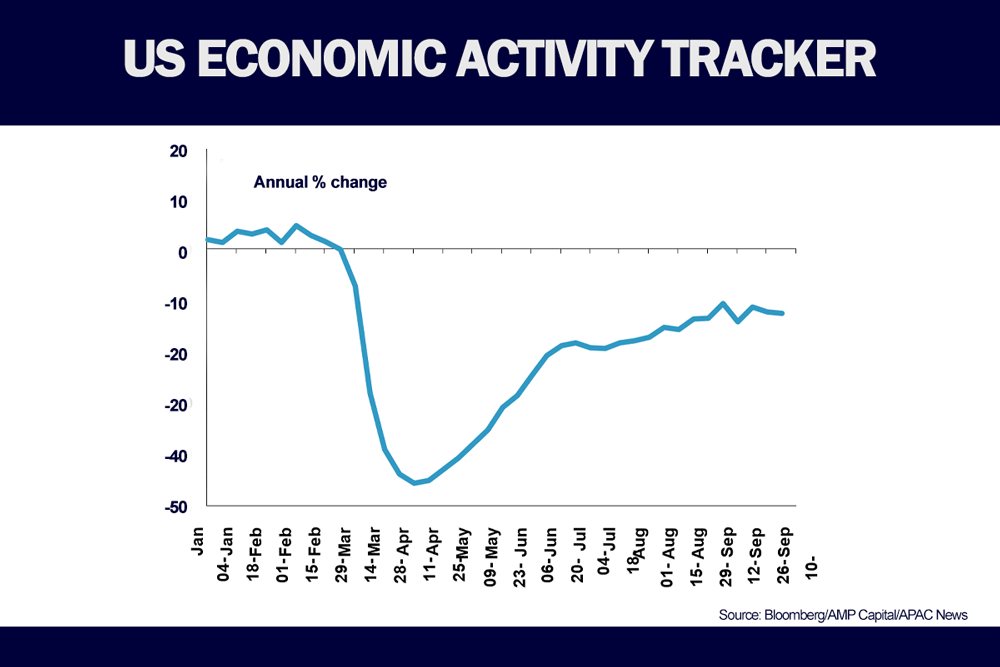
Our US Economic Activity Tracker ticked down again in the last week – with falls in consumer confidence, hours worked, rail freight, and retail traffic – suggesting the US recovery may be stalling again and highlighting the need for additional fiscal stimulus.
Australian cases trending down
Australia is continuing to see new coronavirus cases remaining low and deaths continuing to fall. Unfortunately, the decline in new cases in Victoria may not be fast enough to see the move to Step Three of the reopening by 19th October. NSW has also seen a spike in new community transmission cases, further delaying a reopening of the Queensland/NSW border.
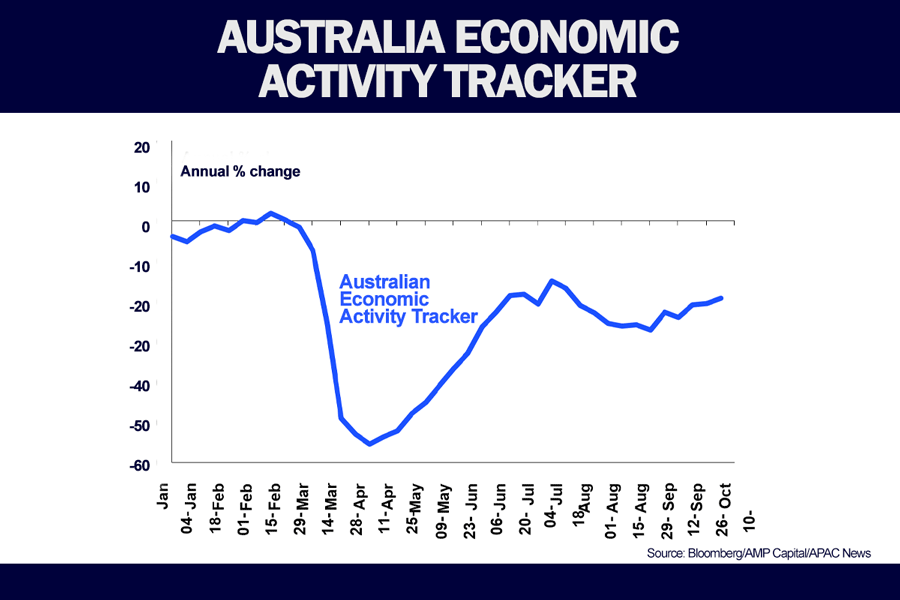
The decline in new cases has seen our Australian Economic Activity Tracker continue to hook up from August lows with gains over the last week in consumer confidence, restaurant bookings, traffic, credit card transactions and mobility. Expect the trend to remain up as Victoria gradually reopens and other states continue to recover.
Trump’s COVID-19 creates confusion
It might have been hoped that President Trump’s coronavirus infection would lead to a more sensible US response to the virus. Particularly after he said he “learned a lot” about it. But his actions over the last week—the drive-by for fans, the early return to the White House when likely still contagious, the defiant show of removing his mask at the White House balcony, his tweet that coronavirus is less deadly than the flu, etc, at a time when multiple members of his team have become infected—suggest no such thing.
And it went crazier when early in the week he tweeted that a fiscal stimulus deal needs to get done, only to then a day later put negotiations on hold till after the election (despite Fed Chair Powell warning of “tragic” risks for the economy) but then do a back flip on the back flip proposing a piecemeal approach (perhaps after some of his team reminded him that he has more to gain from a deal than the Democrats) only to then shift back towards supporting a comprehensive stimulus package after Democrats rejected the piecemeal approach and on Friday say he now wants a bigger package than the $2.2trn the Democrats are proposing which was then contradicted by other comments from the White House!
Maybe Trump is starting to get desperate. So, who knows where this ends up in the next few weeks. The good news in all this is that Trump would have been given the absolute best available coronavirus treatments and so his seemingly speedy recovery holds out hope for many others who catch it. It’s interesting that Trump relied on experts (doctors) to fix him rather than some of the things he has advocated over the last six months (like injecting disinfectant)!
The Australian Budget big boost
The Budget provided little in the way of surprise because many of the measures had been preannounced or leaked. The main criticisms of it were that: it assumes a vaccine next year; the economic assumptions may be too optimistic; that much of the tax cut will be saved; that it exaggerates the actual tax saving for low income earners; that its too focussed on business; and that it will leave too much public debt. No budget is perfect but our response to these is as follows:
- Most forecasters are assuming some sort of vaccine arrives next year and there is a reasonable chance it will. But even the vaccine fails to arrive it doesn’t impact the Government’s decision to provide more stimulus. It would just make it even more important that it did.
- The Government’s economic assumptions are a bit more optimistic than ours but then again, the Budget contained mores stimulus than we were assuming so this could help in achieving the stronger growth forecasts. That said we are of the view that more stimulus will ultimately be required.
- While some of the tax cuts may be saved, because they are permanent they have a greater chance of being spent, even if some is used to pay down debt this will help support future spending and it should be noted that their cost is less than 10% of the overall stimulus of $160bn this financial year.
- While the Government may have exaggerated the size of the tax cuts for those earning $50000 to $90000 (by including last year’s tax cuts in comparisons), they are still getting an extra tax saving of $1080 this year and tax relief has been focussed on this income group in recent years.
- Non-mining investment has been too low for many years now, so it makes sense to provide incentives for business to invest in the interest of boosting spending now and boosting long term growth potential. And the success of the instant asset write-off for tradies shows that such incentives work.
- The budget blow out will add to public debt and its hard to see it being paid down anytime soon but with borrowing rates so low its affordable and not undertaking stimulus spending would have meant a far weaker economy and worse debt problem down the track.
While there is a tendency to get lost in the details of the Budget and each spending measure (often along political lines), the key takeaway from it is that it is actually pumping significantly more stimulus into the economy. This amounts to an extra $41bn (or 2% of GDP) this financial year taking total stimulus this financial year to $160bn.
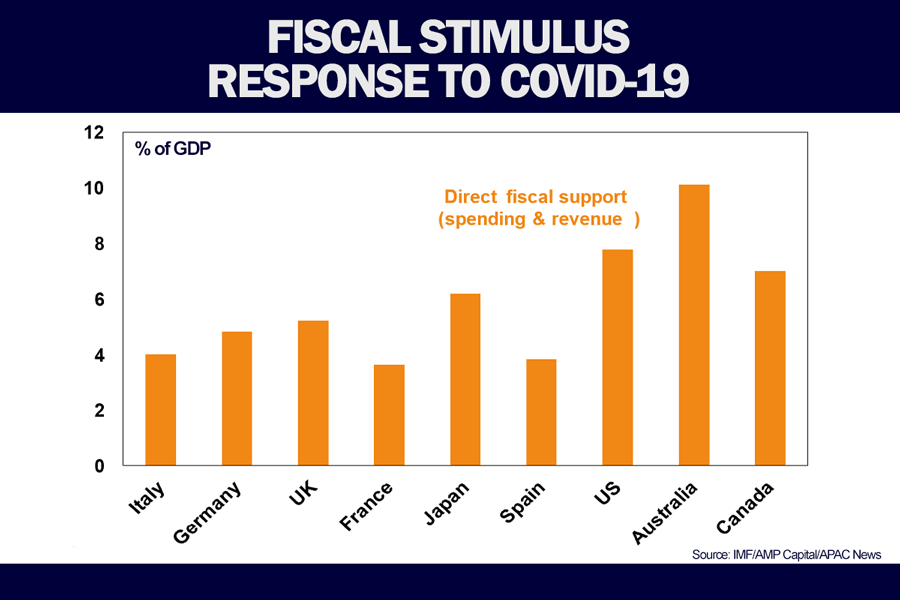
Following the Budget’s further ramping up in stimulus we estimate that total direct fiscal support for the economy this calendar year as a share of GDP is now just above 10%, which is well above that in other comparable countries including the US where extra stimulus has been delayed. This in turn is helping protect the economy and ensuring a faster than otherwise recovery.
Dr Shane Oliver is Head of Investment Strategy and Chief Economist, AMP Capital