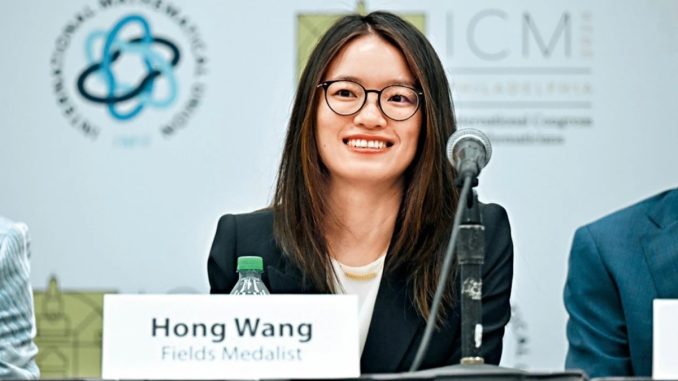
Hong Wang’s Fields Medal win turns mathematics into a cultural phenomenon in China with social media platforms and netizens clamouring to elevate her to celebrity heights as a Key Opinion Leader.
Hong Wang’s historic Fields Medal win—the Nobel Prize equivalent in mathematics—has elevated her from an internationally respected mathematician to a rapidly emerging public figure in China, with her achievement prompting wider discussions about education, female achievement, scientific talent and the country’s ambitions in fundamental research.
Wang, 35, became the first Chinese woman to receive the Fields Medal and one of only three women in the prize’s history. She was recognised for her work in harmonic analysis and geometric measure theory, including important advances relating to the three-dimensional Kakeya conjecture.
An accidental KOL
The first brand to benefit from her success was Cartier. She wore a Clash de Cartier necklace and within days the necklace was sold out in China. She has no commercial agreement with Cartier, she simply owns the necklace.
Alongside the celebrated mathematician, the Cartier brand drew the reputation for academic rigour and intelligence that, up until now, luxury could not get. It was a marketing coup with the marketing department totally unaware.
A bright intelligent woman wore a Cartier product and the internet and social media did the rest.
Chinese social media users have discussed not only her research but her personality, appearance, interests and lifestyle. According to Le Monde, users on platforms including RedNote have discussed her fashion, while Weibo users have highlighted her interest in manga.
This is an important development because it suggests that Wang is beginning to occupy a space normally associated with entertainment figures, entrepreneurs and online influencers rather than academics.
Achievement in a still male dominated field
The award was particularly significant in China because Wang and fellow mathematician Deng Yu became the first Chinese nationals to receive the Fields Medal. Their success was widely celebrated by Chinese universities and state media as evidence of the country’s growing contribution to global mathematics. However, Wang’s impact has extended well beyond the academic community.
Her personal story has proved an important part of her appeal. Born in Guilin, Guangxi, Wang entered Peking University at 16. She initially studied earth and space sciences before moving into mathematics and eventually pursuing advanced study overseas, including a doctorate at MIT.
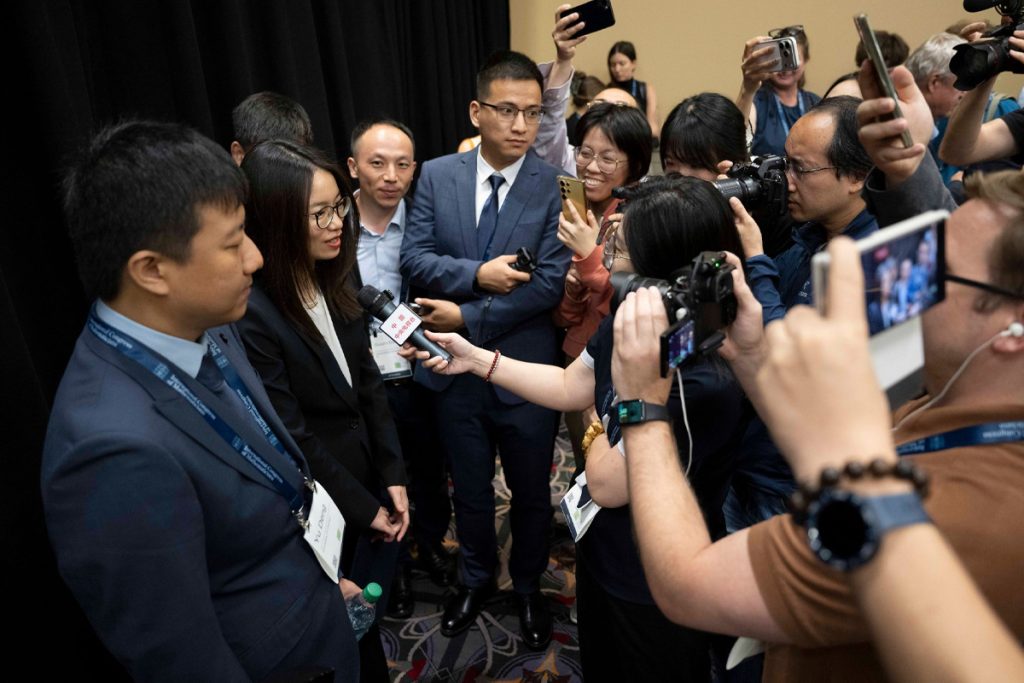
For a Chinese audience accustomed to an intensely competitive education system, her unconventional academic journey has particular resonance. Her career demonstrates that exceptional talent does not necessarily emerge through a straightforward path of examination results, elite institutions and predetermined career choices.
That message has helped transform Wang into a role model for a younger generation.
Her gender is also significant. Although women represent a substantial proportion of university students and researchers in China, they remain under-represented at the highest levels of mathematical and scientific achievement. Wang’s success therefore carries symbolic importance beyond the mathematical community.
Her Fields Medal has provided Chinese students with a highly visible example of a woman achieving global recognition in one of the most intellectually demanding disciplines.
Her hometown has also benefited from the attention. Reports have indicated that visitors have gathered outside the rural home in Guangxi where Wang spent her childhood, turning an otherwise ordinary location into an unexpected destination associated with one of the world’s most prestigious scientific awards.
The phenomenon illustrates how rapidly China’s social media ecosystem can transform an academic achievement into a broader cultural story.
Yet Wang’s emergence as a public figure has also generated a more serious debate about China’s education and research systems.
Her success raises a fundamental question: why did a mathematician who represents such a high level of Chinese intellectual achievement conduct much of her advanced education and research outside China?
Wang studied at leading institutions overseas, including MIT, and has established her research career internationally. Her story has therefore prompted discussion about whether China’s universities provide enough flexibility and intellectual freedom to develop exceptional researchers.
A templar for future research
Her success has also coincided with changes in the way some Chinese universities evaluate academic performance. Institutions have increasingly questioned systems that place excessive emphasis on publication numbers and other easily measured indicators, with greater attention being given to the significance and originality of individual research contributions.
Currently a professor at New York University, she obtained her doctorate at MIT (Massachusetts Institute of Technology) in 2019, arguably the world’s most reputable breeding ground for mathematicians. The latest QS World University Rankings rates MIT as the top global university for mathematics. China’s top university, Tsinghua University ranks 12th.
In this context, Wang has become more than a symbol of national scientific pride. She represents a potentially different model of Chinese intellectual achievement — one based on originality, persistence and international collaboration rather than simply institutional affiliation or examination performance.
Her Fields Medal has also given mathematics an unusual degree of visibility in popular Chinese culture. An area of study that is normally distant from mainstream public attention has suddenly acquired a recognisable human face.
Whether Wang becomes a long-term Chinese public intellectual or simply experiences the intense burst of attention that often follows a major international award remains uncertain.
But the immediate impact is clear. Her achievement has generated a national conversation about who succeeds, how exceptional talent should be nurtured and the role China should play in global science.
For a country seeking to establish itself as a world leader in innovation, those questions are considerably more important than the medal itself.
Hong Wang’s greatest cultural contribution may therefore prove to be not simply demonstrating that a Chinese mathematician can win the world’s highest honour in mathematics, but encouraging China to reconsider how its next generation of exceptional minds should be educated, supported and allowed to flourish.