The collapse of Capital Guard has become one of Australia’s most significant financial services failures of 2026, leaving some 80 investors, who’ve lost a combined total of $17.4 million, unlikely to ever see their money again.
Once against the conduct ASIC (Australian Securities and Investments Commission) is in the crosshairs, with serious questions raised as to its regulatory oversight, and broader questions about investment scams and the sale of fixed-income products.
The reported downfall of the Sydney-based Capital Guard gathered pace in June after ASIC took a series of escalating enforcement actions, culminating in the Supreme Court of New South Wales ordering the company be wound up and independent liquidators appointed to investigate its affairs.
It was too late for those who had deposited funds in the failed investment scheme that offered clients fixed income bond investments, marketing them as being less volatile than investing in shares.
Small investors hit for everything
Last week the ABC’s 730 Report interviewed two victims who’d each lost $750,000 to Capital Guard. Tammy Lindrum is the great niece of former world billiards champion Walter Lindrum, recognised as one of the legends of the game. Lindrum and her husband invested their entire retirement savings with Capital Guard.
Soon after making the investment, they were invited to a rooftop bar in Melbourne by the investment company’s director Vassos Dimitriou. Says Lindrum, Dimitriou promised $50,000 of sponsorship money to a charity, named for her great uncle, the Women’s Billiards and Snooker Network.
Capital Guard did not have a Melbourne office, but boasted a head office in one of the most prestigious office towers in Sydney, 1 Macquarie Place, that offers sweeping views of Sydney Harbour. However, it was not an office occupied by Capital Guard, instead a serviced office run by Servcorp.
Dimitriou, whose address is listed on ASIC records as a suburb on the outskirts of Melbourne has apparently gone to ground.
The second investor, Perth man Ziggy Szmidt also invested his life savings. Capital Guard convinced him he could mitigate his investment risk by spreading his funds across seven different products. At 72 years old, and hoping to have enjoyed his retirement, he’s now a full-time Uber driver trying to make ends meet.
Szmidt invested with Capital Guard after the alarm bells had already gone off.
Capital Guard had sold $100,000 in bonds for a Macquarie Bank fund that didn’t exist. Macquarie discovered the fake fund had been set up and in early 2025 and posted a warning on the scam alert page of its website.
The bank says it cooperated with ASIC in its investigations; however, it took over one year for Capital Guard to be shut down.
While investors normally find comfort in knowing they are investing in a proper company with an ASIC issued AFSL (Australian Financial Services Licence), there are questions as to how rigorously companies with those licences are being monitored on an ongoing basis.
Red flags missed by ASIC
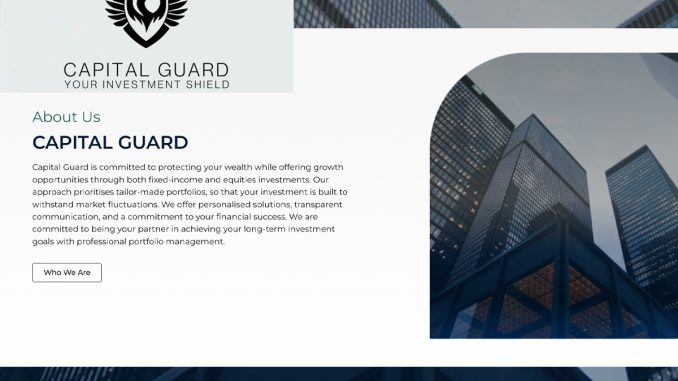
Capital Guard had a slick website that was able to entice investors. There were red flags that small investors might not have picked up on, but regulators should.
The since deleted website featured nothing but photo library stock images with the “Who we are” section of the site illustrated with an image of a hotel in the United Arab Emirates. What should have set off alarm bells is that there was no mention of the principals of the company.
Details on the actual company and who was running it were either scant or written in very general terms. The English across its text was American not UK English, as is the accepted norm in Australia.
Its company phone number, presumably taken over by the corporate regulator, now directs callers to contact ASIC for enquiries.
As a company that sold bond-based fixed income returns, its website told investors, “Bonds: offer fixed returns and prioritize repayment if a company defaults, making them a safer, more predictable option. They’re great for conservative investors.”
Capital Guard attracted conservative investors, but the most painful lie was in plain sight—there would be no repayment if the company itself defaulted.
Social media scammers
Capital Guard relied on a broad social media and public relations campaign that included Facebook and Instagram pages purporting to educate investors.
Its Instagram page feed featured a series of 37 video presentations entitled “Bond Myth Busting”. The biggest myth was Capital Guard itself.
The company also paid for articles on investment websites Business News Australia, Broker Daily and MacroBusiness.
Such articles gain little traction, what they do is boost Google rankings so as to give investors comfort when they Google a company name.
Now a Google search reveals a $17.4 million scam, a trail of shattered lives and questions as to how Capital Guard kept up its ruse for so long.
No lessons from Sterling First
In 2019, Perth-based Sterling First collapsed, along with it more than one hundred people, mostly older retirees, lost a combined total of $18.5 million.
Sterling First marketed a retirement strategy that combined the sale of a family home with long-term residential leasing arrangements, presenting the model as a way for retirees to unlock equity while maintaining housing security.
An inquiry was subsequently conducted by the Senate Economics and References Committee.
Committee members, Labor senator Deborah O’Neill, One Nation senator Malcolm Roberts and Australian Greens senator Nick McKim all slammed the regulator for not doing its job. ASIC whistleblower Niall Coburn told the committee that the corporate regulator had, time and time again, failed in its duty to protect investors.