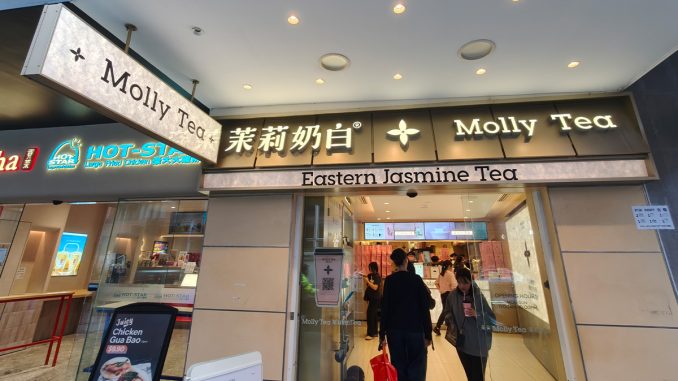
Louis Vuitton went to court in China to protect one of the most recognisable symbols in global luxury. It sued bubble tea chain Molly Tea for trademark infringement and then, almost immediately, found itself facing a problem judgment could not easily solve.
In June 2026, the Suzhou Intermediate People’s Court ordered Shenzhen-based milk-tea chain Molly Tea to pay Louis Vuitton 10.3 million yuan — about US$1.5 million — after finding that Molly Tea had infringed seven of Louis Vuitton’s registered four-petal floral trademarks. The award comprised 10 million yuan in economic damages and 300,000 yuan in legal costs. Molly Tea was also ordered to stop using the disputed design and publish statements intended to eliminate the impact of the infringement. The company has said it intends to appeal.
The dispute centred on Molly Tea’s four-petal flower logo and its similarity to the floral motifs that form part of Louis Vuitton’s famous monogram. Louis Vuitton’s monogram dates back to 1896 and has become one of the most valuable pieces of visual real estate in fashion. The company’s trademarks are protected in China and elsewhere, and the court found that Molly Tea’s use across branding, store decoration, packaging and promotional material crossed the line into infringement.
On paper, it was a decisive victory for one of the world’s most powerful luxury brands. In the court of Chinese public opinion, however, the result was far less comfortable.
There was, therefore, a straightforward intellectual-property argument: Louis Vuitton had registered the marks, built enormous commercial recognition around them and was entitled to prevent another company from using confusingly similar designs.
A cultural argument
But the Chinese reaction was not simply about trademark law. The case quickly became a cultural argument about who owns traditional-looking Chinese imagery.
Chinese social media users and state-linked media questioned whether Louis Vuitton could legitimately claim exclusive commercial control over a relatively simple four-petal floral motif. Critics pointed to historical Chinese decorative patterns, including imagery associated with Tang Dynasty artefacts, arguing that floral designs resembling the Louis Vuitton motif existed centuries before the French fashion house created its monogram. The state-run Beijing Daily questioned why a Chinese company should have to pay more than 10 million yuan to a French company for a design that some Chinese commentators regarded as resonating with China’s own artistic heritage.
That changed the nature of the story. Instead of being simply “Louis Vuitton protects its trademark from imitation”, the story became, for some Chinese consumers, “French luxury giant claims ownership of a design that looks Chinese”. That distinction matters enormously in the Chinese market.
Louis Vuitton has spent decades building an image in China based on exclusivity, craftsmanship, heritage and international prestige. Its products are associated with wealth and status, but also with the idea of a sophisticated global luxury culture. The company’s success depends not merely on legal ownership of its trademarks but on consumers wanting to associate themselves with those trademarks.
The Molly Tea controversy potentially cuts against that proposition.
The irony is that Louis Vuitton’s extraordinary brand recognition was central to its legal victory.
The court considered the strength and recognition of its trademarks when assessing the infringement and damages. But that same recognition made the dispute far more visible. A little-known company could not have generated anything like the same national conversation.
Big enough to handle the verdict
Molly Tea, meanwhile, was hardly an insignificant local operator. Reports put its network at roughly 2,300 stores across China, with more than 50 additional outlets overseas. Its target market includes younger consumers — precisely the demographic whose attitudes towards foreign luxury brands are changing rapidly.
For Molly Tea, the lawsuit transformed a relatively obscure logo dispute into national publicity. For Louis Vuitton, it transformed a routine act of trademark enforcement into a debate about cultural ownership.
Luxury companies have traditionally treated aggressive trademark enforcement as essential to maintaining exclusivity. If competitors can freely copy distinctive designs, the value of the original brand can be diluted. Louis Vuitton therefore had a legitimate commercial reason to act. Yet brand value is not created in a courtroom, it exists in the minds of consumers.
And the Chinese response demonstrated that consumers can interpret the same legal victory very differently from the lawyers and trademark specialists who secured it.
The backlash does not necessarily mean Louis Vuitton has suffered a measurable or lasting decline in sales or brand value in China. However, there is evidence that the brand may be struggling after shutting down its store in the southwestern province of Guizhou.
But there is evidence of reputational friction. The ruling generated widespread discussion, with Chinese commentators questioning the relationship between international trademark protection and traditional cultural motifs. Chinese state media amplified those concerns, while online commentary included accusations that Louis Vuitton was attempting to monopolise designs that resembled historic Chinese patterns.
Challenging Chinese tradition
That is a very different outcome from the one Louis Vuitton presumably wanted. The company succeeded in telling a court that its four-petal flower was a valuable and recognisable trademark. But the controversy encouraged millions of people to ask a more uncomfortable question: why should Louis Vuitton own something that looks, to them, like a traditional Chinese decorative motif?
There is another irony. Louis Vuitton’s monogram was itself influenced by artistic currents outside France, including Japonism and neo-Gothic ornamentation. The company has always presented the monogram as an example of creative synthesis. Its modern commercial power comes from more than the shape itself; it comes from 130 years of history, marketing and association with luxury.
That may ultimately be the most important lesson from the Molly Tea affair. Louis Vuitton won the legal battle because its logo has enormous commercial recognition. But the controversy showed that recognition can work both ways. A famous logo attracts imitation. It also attracts scrutiny.
In China, Louis Vuitton may have succeeded in defending its intellectual property while simultaneously exposing the vulnerability of its cultural positioning. The company proved that it owns its trademark. It did not prove that Chinese consumers will necessarily accept the cultural meaning attached to it.
For a luxury brand whose greatest asset is not a piece of fabric, leather or metal but the emotional meaning attached to a symbol, that distinction could matter far more than the 10.3 million yuan awarded by the court.
Louis Vuitton won the case against Molly Tea. The more difficult question is whether it won the argument.