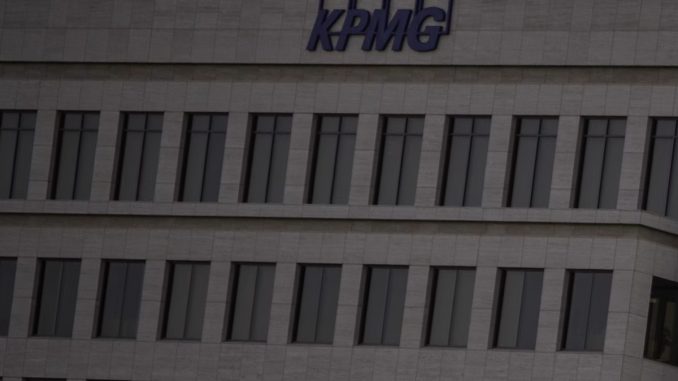
KPMG whistleblower Brendan Lyon’s court win challenge’s the Big Four’s cosiest lurk, immunity from prosecution. Stephanie Tran reports.
Stephanie Tran (MW Media)
Winning a protective costs order in the NSW Supreme Court may not sound like much but it could have major implications for liability protections enjoyed by Australia’s Big Four consulting firms.
Earlier this month, Justice Tim Faulkner ordered that any costs that may ultimately be awarded against KPMG whistleblower Brendan Lyon in the proceedings against accountancy peak body and Big Four advocacy group CA ANZ be capped at $25,000.
The order is significant because CA ANZ had estimated its recoverable costs for the litigation at between $409,000 and $463,000, and without the protection, Lyon argued, the potential exposure to hundreds of thousands of dollars in adverse costs would force him to abandon the case.
The court’s decision means the substantive challenge can now proceed without Lyon facing the prospect of a potentially ruinous costs bill if he loses.
Lyon sues for Big 4 accountability
Lyons sued Chartered Accountants Australia and New Zealand (CA ANZ) over its administration of the professional standards scheme, which he says has undermined accountability of the Big Four.
If successful, Lyon’s case could make big four consultants (KPMG, EY, PwC and Deloitte) liable for any damages caused by their work, and create stronger incentives for ethical and competent conduct.
He subsequently left the firm and has become an academic and prominent critic of the structure and regulation of Australia’s major accounting and consulting firms.
His challenge comes amid renewed scrutiny of KPMG and the wider consulting industry.
Challenge to the liability shield
Lyon is challenging the validity of a professional standards scheme approved by the NSW Professional Standards Council in February 2025 and administered by CA ANZ.
The scheme operates under the Professional Standards Act 1994, which allows approved professional associations to limit the civil liability of their members, subject to a statutory framework intended to improve professional standards and protect consumers.
Lyon’s case argues
the Council acted unlawfully in approving the scheme.
Among other things, he alleges the Council failed to properly consider the interests of consumers, the nature and level of claims against CA ANZ members and the association’s risk-management strategies.
He also challenges the decision to extend liability protections to so-called “affiliate members” and to “Category 3 services”.
Category 3 services encompass services performed by a scheme participant that do not fall within the first two categories, potentially extending the liability limitation beyond traditional accounting and auditing work.
The case also alleges the Council relied on claims data that did not include information about the Big Four firms and failed to properly account for gaps in the information used to assess whether the liability limits were appropriate.
Lyon is seeking orders declaring the scheme void or setting it aside. Alternatively, he is seeking the removal of provisions relating to Category 3 services and the monetary ceiling.
A public-interest case
The costs ruling turns in part on the public importance of the challenge, where Lyon’s lawyers argued that the proceedings concern the exercise of statutory power by an independent regulator, and raise questions about the operation of a scheme affecting consumers of professional services.
They argued that the regulation of the accounting and consulting professions, including the Big Four firms, had been the subject of repeated parliamentary scrutiny and that the case raised novel questions about the lawful exercise of public power.
The argument was ultimately accepted sufficiently for the court to make the protective costs order.
“Battle for the very soul”
Macquarie University Emeritus Professor of accounting and corporate governance James Guthrie described Lyon’s litigation as “a battle for the very soul of professional auditors’ accountability in Australia” in an opinion article ($) for the AFR.
Guthrie argued that the asymmetry between uncapped commercial returns and capped liability created a fundamental accountability problem: “To put it bluntly, if a firm’s liability is capped but its profit potential is not, greed is not a character flaw; it is a business strategy.
He also questioned the amount CA ANZ was prepared to spend defending the scheme.
“When a professional body potentially spends almost half a million dollars to prevent a whistleblower from challenging a liability shield, it is no longer defending the public interest or the integrity of the auditing profession; it is acting as a defence shield for the big four’s partners,” Guthrie wrote.
MWM submitted questions to CAANZ – their spokesperson responses below:
Question 1: What is CAANZ’s response to Mr Guthrie’s characterisation of the case?
“CA ANZ is not seeking to prevent a whistleblower from bringing a legal challenge. Professor Lyon’s proceedings challenge the Professional Standards Council’s approval of the CA ANZ Scheme and have been brought against the Professional Standards Council as the first respondent and CA ANZ as the second respondent.”
“The recent Court decision concerned Professor Lyon’s application to cap his exposure to any adverse legal costs order only in the event that his challenge is not successful, and did not determine any of the substantive issues, which remain before the Court.”
“CA ANZ’s long-standing advocacy for stronger whistleblower protections is well documented and inconsistent with any suggestion that we oppose whistleblowers. Supporting whistleblower protections and defending the validity of a statutory professional standards scheme are two separate issues.”
“The CA ANZ Professional Standards Scheme protects consumers by ensuring access to a consumer complaints process and mandatory professional indemnity insurance where a professional services engagement results in a civil claim for court-awarded damages.”
“The Scheme is designed to deal with professional negligence claims, such as mistakes in advice, tax work, audits or financial reporting. It does not cover deliberate misconduct such as fraud, dishonesty or breaches of trust.”
“The first CA ANZ Scheme commenced in 1997, and the current Scheme is one of 19 approved schemes (alongside schemes in place for lawyers, valuers and building surveyors).”
“It applies to approximately 30,000 members who work in public practice, the majority in sole, small and mid-tier practices in Australia.”
Question 2: Will the legal costs for this matter be funded using member contributions made to the CAANZ?
“CA ANZ manages legal and other operating expenses through its established governance and financial management processes.”
This article was republished from Michael West Media