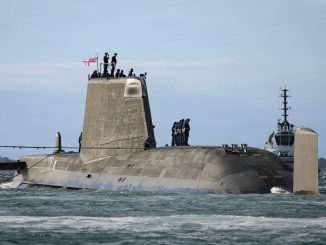
The Defence Legislation Amendment (Accelerating Capability and Protecting Bases) Bill 2026 rammed through parliament in less than a month, giving US military powers to override Australian laws. While Paul Keating says AUKUS is not about nuclear submarines but US military bases.
The government guillotined debate in the Senate—using its numbers to force a vote in just one hour without any proper debate—and now we have perhaps the most draconian piece of defence legislation ever passed.
In short, the law allows the minister and/or up to 50 different officials in the Department of Defence designate areas to be defence facilities; in some cases, overriding state, territory and commonwealth laws.
In addition, these powers extend to foreign defence personal (i.e., the US military), private contractors and employees of foreign weapons makers.
A person protesting outside of a facility or taking photographs, even if it has not been publicly revealed as a defence zone—such as an AI data centre in a suburban neighbourhood—now faces up to seven years imprisonment and a $150,000 fine.
In a comprehensive online critique of the laws, under the title “Empowering federal Ministers to make secret changes to laws”, Australia’s preeminent constitutional law expert, Professor Anne Twomey said the legislation was so quietly and expeditiously slammed though the parliament that she was only made aware of its existence on the day the law was passed.
She noted the bill was examined by the Parliamentary Joint Committee on Defence—which precludes independents and minor parties from its membership. She called the exercise, “An extremely short box ticking inquiry [and] only those who supported the bill were invited to give evidence and only those who supported the bill, being the major parties who had members on the committee.”
The new laws are wide open to High Court challenge, for one on the grounds of freedom of political communication. Twomey says, “All up, this is a very complex amending law which involves significant departures from orthodoxy in how our system of government works. It reads as if it was an ambit claim from Defence which was intended to be negotiated down to something reasonable but was just waved through at the commonwealth level and the parliamentary level. Nothing to see here.”
Protected assets
The passage of this legislation not only highlights defence assets and the potential for Australian laws to be overridden by the US military in conducting its operations on Australian soil. Greens leader David Shoebridge pointed out to the senate, as the only senator afforded time to speak against the bill, Assistant Defence Minister Peter Khalil, who introduced the Bill to parliament, was identified in the Wikileaks cables as a protected US asset.
Said Shoebridge, “This is the same bloke [Khalil] who’s having his name hidden while he’s giving secret information to US intelligence and US embassy officials.
“Literally a US protected asset is one of the assistant ministers for the Labor government, and he’s the bloke you give the job to shepherd this bill through. You can’t make this stuff up, can you?”
Shoebridge, who was a barrister before entering parliament, gave an example, “Say you make one of these [US weapons maker] Lockheed Martin employees a defence security official,” he said. “They’re there at Pine Gap. They see a protest happening.
“They think, ‘Oh, you might block the road; therefore, in the future you might commit a criminal offence,’ and they’re going to detain you.
“You could literally be arrested by a defence contractor, or you could be arrested by a member of the US military, because they think you might commit an offence. Those are the powers that are being given here. I mean, what the bloody hell?”
Independent ACT senator, David Pocock put forward a motion that noted the bill was rushed through then senate without adequate time for debate. That motion was voted down by the government and opposition.
In an opinion piece, human rights lawyer, Greg Barns SC said, “The new defence law is so poorly drafted it will be hard to know if you are breaking it—but then maybe that’s the whole idea.”
AUKUS all about US bases in Australia
In an interview with Crikey, Paul Keating says recent developments on the AUKUS front—specifically the US Congressional Budget Office saying the US does not have the capacity to build nuclear submarines to honour the AUKUS agreement—the former prime minister says it was never about submarines but opening up Australia for US bases.
He told Crikey, “The report of the US Congressional Budget Office further reinforces my view that, when ‘push comes to shove’, no American president is going to lightly or easily release three to five Virginia attack-class submarines to Australia, reducing the US Navy’s effective power in the Pacific.
“What the United States has always wanted with AUKUS was not about submarines, but the need of an American submarine base in Australia. A base to offset the vulnerability of the US naval base in Guam to Chinese mainland attack. And an American base in Australia (not a pretend Australian one), is what the Australian government is giving them — what the Americans see as a southern alternative to Guam.
“And it goes without saying, an American naval base will conduct itself subject to American command, whether it is resident in continental Australia or not.
“Given the significance of geopolitical events in Shenzhen last week, where President Xi and President Trump present themselves as Pacific partners, the likelihood of US bases in Asia being employed to attack the Chinese mainland or Chinese military assets is becoming more remote.
“What then will be the point of a new American base in Australia?
“Or the more general question, could a handful of bases in the Pacific outside the second island chain do any mortal damage to China anyway? And if not, do US bases become stranded assets, which in the view of some current and important Washington strategists, simply remain to become future targets.”