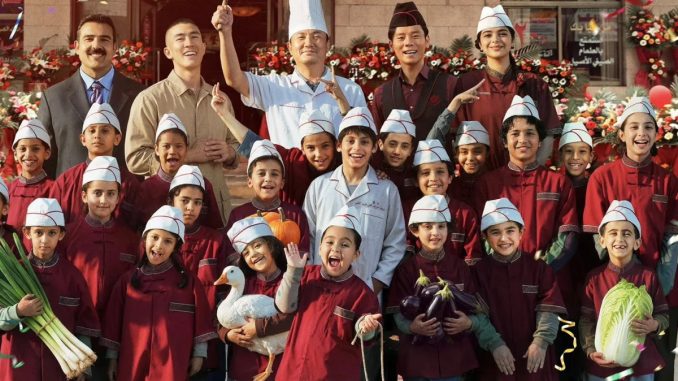
China’s latest box office hit, Once Upon a Time in the Middle East weaves its anti-war message through the prism of all sides in a brutal war. While its theme is ultimately the futility of war this film explores that theme through different characters from three different cultures, with a multitude of motivations.
There is something deceptively simple about Once Upon a Time in the Middle East. At first glance, Wen Muye’s ambitious new Chinese film appears to be a fish-out-of-water comedy about a Chinese chef trying to make a living in the Middle East. But the film gradually transforms into something much darker: an epic anti-war drama about friendship, survival, terrorism, occupation and the human cost of political decisions made thousands of kilometres away.
Starring Chinese comedy superstar Shen Teng as chef Xu Fu, the 2026 film is set in the fictional Middle Eastern city of Bahata. Although the country is never explicitly identified, the references to the 2003 American invasion, the dissolution of the Iraqi military and the subsequent insurgency make the historical setting unmistakable.
Xu arrives in the Middle East primarily for money. Burdened by debt and separated from his family in China, he takes a job as head chef at the Loong Restaurant. The literal translation from the Chinese movie title is “Welcome to the Loong Restaurant”.
His ambition is hardly heroic: he wants to earn enough to resolve his financial problems and return home.
The restaurant, however, becomes the film’s emotional centre. Xu develops a friendship with manager Ma Junsheng, played by Jiang Qiming, and becomes involved with local characters, including the restaurant’s owner and a young orphan, Seif, played by Omar Sherif. The restaurant becomes a meeting place where locals, foreigners, soldiers and refugees temporarily coexist.
Food is therefore much more than a decorative element. It becomes Wen’s metaphor for coexistence.
Xu’s insistence on authentic Chinese cooking initially provides much of the film’s humour. The preparation of dishes is filmed almost sensuously, with the clatter of knives, flames beneath the wok and steam rising from freshly prepared food. Tatler Asia notes that the film deliberately establishes this warmth before an airstrike abruptly changes the tone.
That structural decision is one of the film’s greatest strengths. Wen first gives the audience something worth losing.
Once war arrives, the restaurant changes from a place of commerce into a refuge. The contrast between food and destruction becomes increasingly powerful. A kitchen represents nourishment, family and ordinary life; outside, bombs and bullets represent the collapse of all three.
Shen Teng is particularly effective because he does not completely abandon his comic persona. Instead, Wen uses the actor’s familiarity with comedy to make Xu Fu seem ordinary. He is not a soldier, politician or ideological crusader. He is a working man who simply wants to cook, make money and return to his daughter.
That ordinariness is important. Xu becomes an audience surrogate precisely because he does not initially understand the political forces surrounding him.
An interesting twist is the main characters are all three dimensional. A harsh US Army interrogator’s actions are explained by a superior officers who tells Xu he lost relatives in the 9/11 attacks — oddly a crucial piece of Iraq War history that was not dodged by the film. A young Chinese-American army private befriends Xu but his tough exterior is exposed when he tells the chef all he wants to do is once again see his family.
Xu’s local partner in the restaurant, an influential government official, has his family struggles to deal with and eventually is consumed by the conflict.
The film’s treatment of the war is considerably more complicated than its early comedy might suggest. American forces are depicted through the perspective of civilians caught in the invasion, while the emergence of violent extremist groups is connected to the devastation and instability created by war. The film also portrays terrorism and radicalisation rather than simply presenting one side as entirely innocent.
This is where Once Upon a Time in the Middle East becomes politically interesting.
The film clearly reflects a Chinese perspective on America’s intervention in the Middle East. It presents the 2003 Iraq invasion as a catastrophe whose consequences extend far beyond the battlefield. At the same time, its stated anti-war message is broader than simply blaming one country. The violence committed by insurgents and terrorists is also presented as destructive and morally consequential.
That approach has produced divided reactions. Some reviewers have praised the film for showing different sides of the conflict and for concentrating on civilians rather than military strategy. Others have criticised its melodrama and argued that its political perspective is too simplified.
The film pushes the emotional boundaries of its audience; whether it goes too far is ultimately a subjective assessment.
Some scenes are so carefully engineered to produce a reaction that the audience can see the manipulation coming. One criticism raised by viewers is that the film sometimes substitutes emotional spectacle for subtlety.
Yet this is also part of its cinematic identity. Wen Muye is not making a detached historical documentary. He is making a popular war drama, and the film operates on the scale of a blockbuster. The explosions are large, the emotions are large and the moral questions are deliberately presented in accessible terms.
Visually, the achievement is considerable. Because filming in a genuine conflict environment was impossible, the production constructed a large-scale Middle Eastern town at Qingdao Oriental Movie Metropolis. Tatler Asia reports that the set covered approximately 100,000 square metres and contained more than 200 buildings.
That investment pays off. The fictional Bahata feels sufficiently convincing to allow the audience to accept the film’s premise without constantly thinking about the production machinery behind it.
The production values are high and Wen Muye seamlessly transitions his storytelling across the Chinese, American and Arab perspectives of the film and its main characters.
Characters all speak their mother language, scenes in US military facilities are shot with authenticity and a cast of American actors. As were extensive scenes inside an Islamic terrorist training camp where Xu ultimately ends up in his journey through conflict and cultures.
The most effective element, however, remains the relationship between Xu and Seif. Through the boy, the film moves beyond the immediate politics of invasion and asks what happens when children grow up surrounded by violence. The restaurant becomes an attempt to create a small alternative world in which people can eat, work and cooperate despite everything happening outside.
That idea gives the film its emotional power.
Once Upon a Time in the Middle East is not a subtle film, and it does not pretend to be. Its political perspective is unmistakable, its sentimentality is sometimes excessive and its action sequences occasionally overwhelm the quieter human drama.
But it succeeds at something more fundamental. It takes an enormous geopolitical tragedy and reduces it to the scale of a kitchen, a restaurant, a family and a child.
The result is a Chinese war film that is as much about food as it is about bombs — and ultimately about the stubborn persistence of ordinary human life in circumstances designed to destroy it.
For Western audiences, the film is also significant because it demonstrates how the Iraq War can be remembered and interpreted from outside the traditional American and European cinematic perspective. Whether viewers agree with its political framing or not, Once Upon a Time in the Middle East offers a perspective that is increasingly difficult to ignore as Chinese cinema expands its reach internationally.
It is messy, melodramatic and occasionally heavy-handed. But it is also ambitious, visually impressive and genuinely moving. And its central image — a Chinese chef continuing to cook while war rages around him — is difficult to forget.