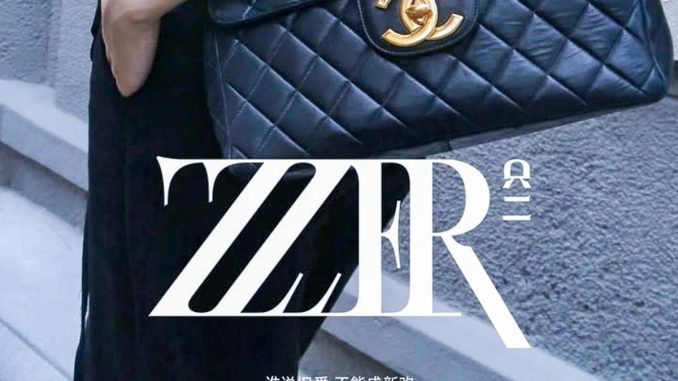
For much of the past two decades, China’s luxury market was built around one powerful idea: luxury meant buying new. Designer handbags, watches, jewellery and fashion were symbols of rising wealth, social status and economic confidence. But that model is changing, and one of the companies at the centre of the transformation is ZZER, the Chinese second-hand luxury retailer and online marketplace.
ZZER, known in Chinese as 只二, began as an online consignment platform and has developed into a significant physical retail presence. Its large warehouse-style stores offer consumers thousands of pre-owned luxury products from brands including Louis Vuitton, Gucci, Dior, Chanel and Hermès. The concept is fundamentally different from the traditional luxury boutique: rather than carefully selected products presented in an exclusive environment, ZZER offers scale, choice and price transparency.
The company’s flagship operation near Shanghai’s Hongqiao transport hub illustrates the change. The store opened in December 2022 with about 3,000 square metres of space and attracted more than 100,000 visitors during its first six months. It was subsequently expanded to almost 10,000 square metres. China Daily reported that the store had sold more than 100,000 products from more than 5,000 international brands.
The attraction is straightforward. Consumers can obtain luxury products for substantially less than the price of new merchandise. At ZZER’s warehouse-style stores, products are displayed in a manner more reminiscent of a supermarket or department store than a traditional luxury boutique. QR codes provide pricing and product information, while the business says it operates authentication procedures to establish the legitimacy of merchandise.
That proposition has become increasingly relevant as China’s luxury consumers have become more price-conscious.
Second hand luxury growth
Bain & Company estimated that China’s mainland personal luxury market contracted by 3% to 5% in 2025, following a much larger decline of 17% to 19% in 2024. At the same time, the Chinese second-hand luxury market grew by approximately 15% to 20% in 2025. Despite that growth, second-hand luxury still accounted for less than 10% of China’s overall luxury market, compared with approximately 20% to 30% in developed markets.
The figures point to an important structural shift. Chinese consumers are not necessarily abandoning luxury. Increasingly, they are changing the way they acquire it.
For younger consumers in particular, second-hand luxury can provide access to brands that would otherwise be financially out of reach. A Chanel handbag, Rolex watch or Hermès product purchased second-hand can offer the brand recognition and perceived status associated with luxury at a considerably lower entry price.
This is potentially significant for the major international luxury houses.
Unravelling the myth of scarcity
The traditional luxury business depends heavily on scarcity, pricing power and the perception that products retain desirability. The expansion of a large secondary market introduces another pricing mechanism. Consumers can compare the cost of a new product with hundreds of pre-owned alternatives before deciding whether to buy.
For some brands, this may create pressure on new-product sales. If a consumer can acquire a relatively recent handbag at a substantial discount, the incentive to pay full retail price is reduced. The effect could be particularly important in categories where consumers have become more price-sensitive.
Bain’s 2025 figures illustrate the problem. Leather goods and handbags declined by 8% to 11% in mainland China, while watches fell by 14% to 17%. At the same time, consumers increasingly considered second-hand alternatives.
But the resale market can also benefit luxury companies.
A functioning secondary market gives luxury products greater liquidity. Consumers may be more willing to spend heavily on a handbag or watch if they believe they can later sell it. That potentially changes the psychological calculation behind luxury purchases: instead of viewing a €10,000 or ¥80,000 product purely as consumption, the buyer may regard part of the expenditure as recoverable value.
This is particularly relevant in China, where the second-hand market was historically constrained by cultural attitudes. Buying used luxury goods was once associated with lower status or financial necessity. That stigma appears to be weakening.
Second hand stigma is gone
The growth of online marketplaces, social media, livestreaming and authentication services has helped normalise the practice. Bain specifically identified livestreaming as an important factor in the expansion of China’s second-hand luxury sector.
ZZER’s physical stores take that development a step further. They turn second-hand luxury from an online transaction into a retail experience. Customers can walk through a warehouse, examine thousands of products and compare prices. The model also allows people to sell unwanted luxury goods and immediately participate in the same marketplace as buyers.
This creates a circular ecosystem: one consumer’s unwanted handbag becomes another consumer’s affordable luxury purchase.
There is also an important economic dimension. China’s prolonged property downturn and cautious consumer environment have encouraged households to reconsider discretionary spending. Reuters reported in 2022 that ZZER was experiencing increased numbers of people seeking to sell luxury goods, while demand from consumers looking for discounted products was also increasing.
The implications extend beyond ZZER itself. Other Chinese resale platforms, including Zhuanzhuan and Poizon, are competing for consumers, while the broader second-hand ecosystem is becoming an increasingly important part of China’s luxury economy.
For international luxury brands, therefore, the rise of ZZER represents both a challenge and an opportunity. It challenges the traditional model of constant full-price consumption, but it may also introduce luxury products to consumers who cannot initially afford them at retail prices. Those consumers could eventually become purchasers of new products as their incomes rise.
China’s luxury market is not disappearing. It is becoming more selective, more price-conscious and increasingly comfortable with resale.
ZZER’s significance lies in demonstrating that luxury in China no longer necessarily means buying something brand new from a marble-lined boutique. Increasingly, luxury can also mean finding the right product, at the right price, in the secondary market.
That change could prove to be one of the most important developments in China’s luxury industry over the next decade.