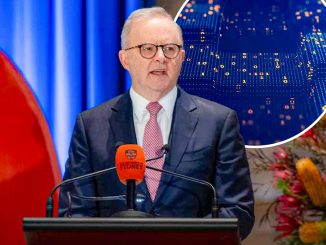
Leaked documents show to the Albanese government is prepared to backtrack on its commitment to protect Australian copyright owners from having AI models use their works. At the same time prime minister Anthony Albanese has signed a declaration with 21 world leaders committing to keeping AI under human control.
In New York this week for the meeting of the United Nations General Assembly, prime minister Albanese has joined 21 other leaders in signing a declaration that guardrails be put in place to ensure AI remains “under human control.”
A coalition of middle powers, including Australia, Finland, Norway, Canada, Singapore and the European Commission, have called on AI companies to develop transparent safety protocols and governments to develop and coordinate common standards.
The statement read, “To realise AI’s potential, industry, governments and society must act now.
“AI must remain under human direction, oversight and control. It must be developed and used in line with international law.”
US president, Donald Trump appears to be caving in to corporate interests. He’s now decided to rename artificial intelligence as “super intelligence.”
The documents were made public by the ABC and reveal the government is considering two options to attract AI infrastructure to Australia.
The government’s broader policy is to make Australia a leader in the establishment of next generation AI infrastructure, but it seems that policy might require the government to acquiesce to major AI companies. One of the reported policies under consideration is allowing the companies to legally use copyright material to train their AI models.
The Australian Financial Review has reported that the draft policies were already known to AI giants including OpenAI, Anthropic, Google and Meta.
It’s not simply a case of another broken promise, it’s another example of an industry dictating to government the regulatory regime under which it will operate.
The policy unfolds
At a major speech in July, prime minister Anthony Albanese announced the establishment of a new Office of AI. As reported by APAC Business Review at the time, the speech was long on rhetoric but provided virtually no detail.
Now that there is detail it’s being hidden from the public.
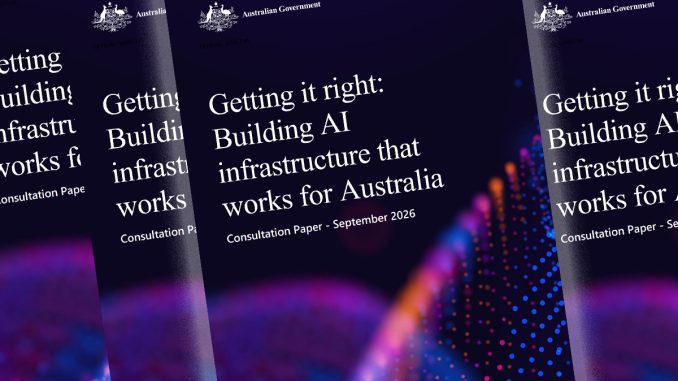
In September the Department of Prime Minister and Cabinet released a 28-page consultation paper outlining the government’s commitment to building AI infrastructure as a means of bolstering Australia’s productivity, sovereign capability and national security.
Five paragraphs are devoted to the issue of copyright with the paper saying, “How copyright treats AI training, provides regulatory certainty for AI companies to invest in Australia and includes strong protections for creators and rights holders will be a key part of the AI standards.”
These platitudes seem to be a mismatch with the proposals now being considered by the government.
Former Australian Consumer and Competition Commission boss Rod Sims told the Australian Financial Review that copyright creators would be left to fend for themselves, saying of the proposed regulatory environment, “It does seem to be offering what the AI companies were after, and doesn’t recognise the market power of the AI companies.”
Why cave in to AI?
The government argues that having frontier AI training capabilities in Australia would help the country participate in the development of the technology rather than simply becoming a consumer of systems developed overseas.
But training sophisticated AI models requires enormous quantities of data, much of which may be protected by copyright. The proposal to allow the use of copyright material for AI training comes from the attorney-general’s department.
ACT independent senator David Pocock, who tabled the documents obtained by the ABC shortly before the ABC story told the senate:
“This would be huge and mean that our legal system would protect AI companies first and Australians second.
“The burden should not fall on Australians to defend the rights over content they hold, create and invest in.”
As it stands the government proposal is to allow copyright owners the ability to opt-out of allowing AI companies access to their material.
Access without pay
The ABC reported the first proposal would give AI companies the option to get a license for training by directly doing deals with groups that represent copyright owners. However, that would include content created by individuals who are not members of those groups and will not be paid.
The alternative proposal is that AI companies would be required to strike deals with a predetermined minimum number of copyright holders. A slide in the government presentation read: “No additional $ would be payable to creators or rights holders beyond deals negotiated to achieve quota.”
The Prime Minister and Cabinet consultation paper makes clear that attracting frontier AI training is a central objective. The issue is what price Australians will pay for their AI framework?