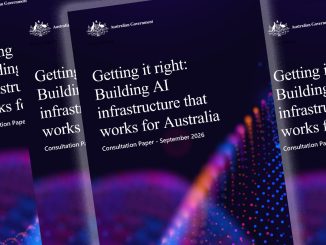
The government sets up a new Office of AI that will provide the framework of legislation for a mandatory set of national AI standards, designed to ensure AI systems are developed and deployed safely and consistently.
Prime minister Anthony Albanese has announced the creation of a new Office of AI in a speech, delivered last week at the University of Sydney, entitled “AI in Australia’s interests”. It was an odd speech, to say the least, long on platitudes but short on detail.
Albanese spent a great deal of time reminiscing about his formative years, finishing his Higher School Certificate and starting his first job at the Commonwealth Bank, “[where] my first task was to try and convince customers… of the need to use this new contraption called an ATM, a hole in the wall.”
The new office will sit within the Department of the Prime Minister and Cabinet, it will be established and run with coordination across a wide range of portfolios, including Industry, Climate Change, Employment, Education, Attorney-General and Defence.
There is now an Office of AI page on the Department of Prime Minister and Cabinet website, it is just two lonely paragraphs.
Perhaps there should have been some consultation with the department so that it could put a little meat on the bone.
Due to its clear impact on healthcare, the Department of Health, Disability and Ageing has already developed an AI framework, however, health didn’t rate a mention in the prime minister’s speech.
There were far more positives outlined in the speech as Albanese called the rise of AI an opportunity rather than a threat. He pointed out unrealised fears of the rise of automation in the latter part of the last century as an example of how the naysayers can get it wrong.
HERE FOR AUSTRALIA
The prime minister announced, “We want more Australian companies and global firms developing AI here. To boost our sovereign capability. To strengthen our national security. And build our economic resilience.”
According to Dan Saldi, the founder of Canberra-based Xaana.ai, the government is not following the prime minister’s lead. Quoted in the Australian Financial Review, Saldi criticised the Finance Department’s decision to adopt OpenAI’s ChatGPT, Anthropic’s Claude and the French-built Mistral as the models to trial its new GovAI chatbot, a secure application for public servants to draft, summarise and verify work that last year received $25.6 million in initial funding.
In its most recent call for expressions of interest for AI services the department stated, “there is no specific, separate stage 1 evaluation weighting for Australian-developed sovereign LLMs or other sovereign capabilities.”
Thanks to the global concentration of technology development, very few countries have announced they will rely solely, or mainly, on sovereign capability in building AI networks.
More countries have either explicitly announced, or indicated, from which countries they will restrict the use of AI technologies. China is top of the list of nations whose AI is unlikely to be picked up by western governments.
PROTECTION FOR SOME BUT OTHERS DON’T WANT IT
A big role of the Office of AI will be in protecting the work of creative artists, the prime minister said, “Let me make this crystal clear, not everything produced in Australia is up for grabs. Australian writers, musicians, artists and journalists must retain ownership and control of their work. Our laws will spell that out, plain as day.”
The Business Council of Australia—whose membership is dominated by foreign owned and foreign controlled companies—cautiously welcomed the announcement. However, its CEO, Bran Black, warned against ‘over regulation’, quoted in The Guardian as saying, “We don’t want to see ourselves get out of step with international counterparts, and that as a consequence, we would lose investment.” Ergo, the Business Council does not want its foreign members to be hampered by Australia’s national interests.
A central feature of the government’s strategy is the introduction of mandatory Australian Standards for AI. These standards will establish clear rules for the construction and operation of large AI data centres, addressing concerns that the rapid expansion of AI infrastructure could place increasing pressure on electricity grids, water supplies and local communities.
Under the proposed framework, future large-scale data centres will be required to fund their own additional electricity generation, pay the full cost of connecting to the electricity grid, reduce power consumption during periods of peak demand and meet strict water-efficiency requirements.