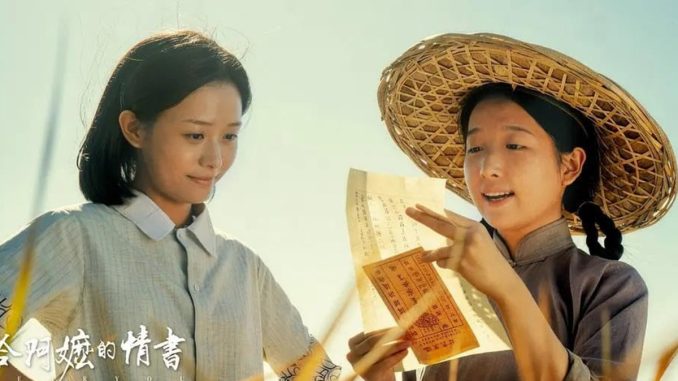
This year a low budget Chinese-language family drama has emerged as one of the biggest box office hits in China, its Australian premiere shows the themes of love, devotion and family are universal.
When a film that cost just A$3 million to make grosses over A$380 million, in just three weeks, at the Chinese box office it’s more than a hit, it is a phenomenon. Dear You is now moving across Asia and the rest of the world.
Its Australian premiere in Sydney played to an audience of more than 1,000 which was excited as the movie began but clearly deeply touched as the story unfolded.
The film tells a deeply personal story centred on family, migration and the enduring power of love across generations.
Rather than relying on famous actors or lavish production values, Dear You draws its strength from relatable characters and universal themes that resonate far beyond China.
The story follows Xiaowei, a young man burdened by debt who travels to Thailand in search of his long-lost grandfather, believing he has become a wealthy businessman. His journey begins as a desperate attempt to solve his financial problems but gradually transforms into an emotional exploration of his family’s hidden history. What he discovers changes not only his understanding of his grandfather, but also of his grandmother, Ye Shurou, whose life has been shaped by decades of waiting and sacrifice.
At the centre of the narrative are the historic qiaopi letters—handwritten correspondence sent by overseas Chinese migrants to their families in China, often accompanied by remittances. These letters served as emotional lifelines during the twentieth century, connecting families separated by war, poverty and migration. In Dear You, they become a powerful storytelling device, revealing forgotten memories and long-kept secrets that bind several generations together.

One of the film’s greatest strengths is its authenticity. Much of the dialogue is spoken in the Teochew dialect rather than standard Mandarin, reflecting the cultural traditions of China’s Chaoshan region. For many viewers of Teochew heritage, particularly across Southeast Asia, hearing their ancestral language on the big screen has been an emotional experience. The film also captures the customs, food and family relationships of the region with remarkable attention to detail.
Director Lan Hongchun has explained that the screenplay was inspired by years of research into the experiences of overseas Chinese communities. By drawing on real stories of migration and family separation, he has created a film that feels genuine rather than sentimental. Although the narrative spans several decades, its emotional core remains firmly rooted in the universal desire to reconnect with loved ones and understand where we come from.
Critics have praised Dear You for avoiding many of the clichés common in modern family dramas. Instead of relying on melodrama, the film allows its emotional moments to develop naturally through quiet conversations, subtle performances and carefully constructed relationships.
The result is a moving portrait of resilience, forgiveness and enduring family bonds.
The film’s commercial success has surprised many within the Chinese film industry. Produced on a relatively modest budget with a largely unknown cast, Dear You became a word-of-mouth sensation, attracting audiences who praised its sincerity and emotional impact. Strong reviews and enthusiastic recommendations helped propel the film to become one of China’s highest-grossing releases of 2026, demonstrating that compelling storytelling can still triumph over expensive marketing campaigns.
Beyond its domestic success, Dear You has also found an appreciative audience overseas. Its release throughout Southeast Asia has resonated strongly with Chinese diaspora communities whose own family histories often mirror those depicted in the film. At the same time, international audiences unfamiliar with Teochew culture have connected with its universal themes of family, identity and belonging.

The film has also sparked broader conversations about migration, cultural identity and the preservation of heritage. While some commentators have debated its portrayal of overseas Chinese communities, most agree that its emotional appeal lies in its focus on ordinary people facing extraordinary personal circumstances rather than political messages.
Ultimately, Dear You reminds audiences that the most meaningful stories are often the simplest. It is a film about remembering those who came before us, recognising the sacrifices that built future generations and understanding that family history is often far more complex than it first appears.
In an age when cinema frequently prioritises spectacle over substance, Dear You stands as a welcome reminder that honesty, compassion and human connection remain among the most powerful storytelling tools of all.