A box of Mid-Autumn Festival mooncakes has triggered an extraordinary public relations crisis for Tiffany & Co. in China, after a customer who says she spent more than 200,000 yuan (about A$43,000) on jewellery complained that a promised gift was never delivered.
What began as a relatively minor customer-service dispute at a Tiffany store in Chengdu rapidly became one of China’s most talked-about luxury retail controversies, generating intense debate about customer service, privacy, corporate accountability and the power, and pitfalls, of social media.
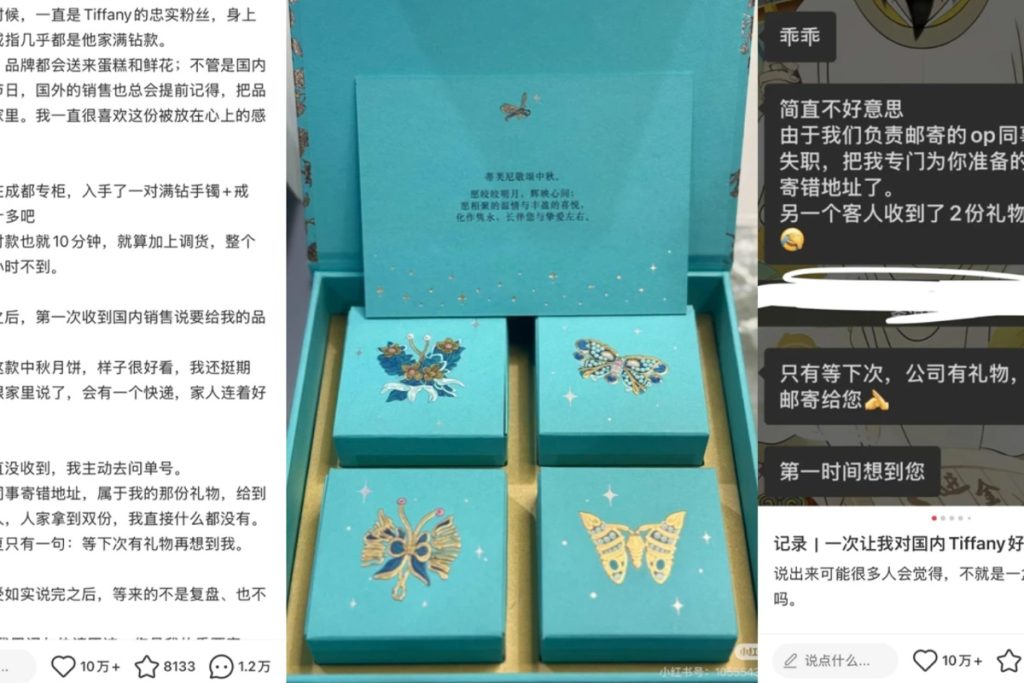
The customer said she had purchased a diamond bracelet and ring from Tiffany during a visit to China in 2025, spending more than 200,000 yuan. On September 8 this year, a sales representative contacted her to say the store would send her a Tiffany Mid-Autumn Festival mooncake gift box.
Because the customer was overseas, she provided the address of her family home in China for delivery. But when the Mid-Autumn Festival arrived, the mooncakes had not appeared.
According to the customer’s social media posts, she contacted the salesperson to ask for the courier tracking information. She was then told that the package had been sent to another customer because of an address error. The initial response was reportedly that the next time the company had a gift available, one would be sent to her.
The customer subsequently published her account on Xiaohongshu, China’s hugely influential lifestyle and consumer social-media platform.
Tiffany cookies crumble
The hashtags “Tiffany mooncakes” and “Tiffany covering up” became trending topics, with users focusing not simply on the missing gift but on what they regarded as a striking mismatch between Tiffany’s luxury image and the way the complaint was handled.
The controversy became even more damaging when the store offered a different form of compensation: locally purchased Chengdu pastries.
Reports put the value of the pastries at roughly 20 yuan, creating an irresistible contrast for social media — a customer who had spent more than 200,000 yuan at one of the world’s most prestigious jewellery brands receiving a small packet of local pastries after being promised a branded luxury gift box.
Social media posts deleted
The situation escalated further when the customer said her social-media posts had been restricted or removed after she complained. She questioned whether someone connected with Tiffany had attempted to suppress her criticism.
There is no evidence establishing that Tiffany itself caused the restrictions, and the question of who submitted complaints against the posts remained unresolved. That distinction became increasingly important as the controversy developed.
Tiffany eventually moved the matter beyond the individual store.
On September 28, the customer said she received an apology from Tiffany China’s retail management team. The following day, the company said an investigation had found that the mooncake delivery problem resulted from an address-copying error by store operations staff. It also acknowledged shortcomings in the employee’s subsequent communication and said the matter had not been escalated appropriately.
Tiffany announced a series of corrective measures, including a dedicated customer-relations contact, a 24-hour escalation mechanism for complaints, tighter supervision of store gift-delivery procedures and additional compliance training for employees.
The company also said the relevant employees would be dealt with under its internal rules. On September 29, Tiffany China publicly apologised, saying it attached great importance to the incident and would improve its service and privacy-management procedures.
By then, the controversy had developed a life of its own.
The customer reportedly established around 20 online discussion groups, with thousands of people following developments and, according to reports, some supporters contacting Tiffany’s global headquarters.
Then came another dramatic turn. As details spread online, some users identified the social-media accounts of the Tiffany employees involved in the dispute. Reports subsequently emerged of personal attacks, insults and the circulation of private information involving the employees and, in some cases, their families.
The son of one of the employees told Chinese media that the women had become targets of online harassment, including attacks concerning their appearance and false sexual allegations. The customer’s position also softened, with reports saying she acknowledged that she had not expected the dispute to spread so widely or for employees to be subjected to personal attacks.
A reversal in public opinion
Initially, the story was framed as a classic David-versus-Goliath dispute: an individual customer confronting an enormous international luxury brand over poor service. But as more information emerged, some social-media users began questioning whether a consumer complaint had gone too far.
The controversy highlights a fundamental problem for luxury brands operating in China. Customers are not simply purchasing jewellery, handbags or watches. They are also purchasing an experience — personal attention, recognition, exclusivity and the expectation that even small promises will be honoured.
For a customer who spends more than 200,000 yuan, a mooncake box may have little financial value. Its symbolic value can be enormous. That is why the Tiffany incident has become much bigger than a missing Mid-Autumn gift.
It has exposed the fragile relationship between luxury brands, their customers and frontline employees in China’s hyper-connected consumer economy. A small operational mistake became a reputational crisis because the original failure was compounded by poor communication, questions over customer privacy and an uncontrolled social-media backlash.
For Tiffany, the lesson is particularly uncomfortable: in China’s luxury market, the value of a customer promise is not measured by the price of the gift. It is measured by whether the brand keeps its word. And in the age of Chinese social media, a broken promise can travel considerably further than a mooncake box ever will.