The Albanese federal and Minns NSW state governments’ bailout of Rio Tinto’s Tomago aluminium smelter is the fifth large corporate rescue in two years. Yet again corporate welfare wins the day as profits are privatised and losses nationalised. Aleta Moriarty works the latest bail out as $2.5 million per job.
Alex Moriaty (MW Media)
Last week it was announced that a $2.5 billion rescue package, the largest ever for an Australian smelter, built around a subsidised long-term electricity contract, would be delivered to Rio Tinto, majority owner of Tomago Aluminium, the Anthony Albanese federal government and the New South Wales government of premier Chris Minns.
The Tomago Aluminium smelter is in the Hunter Valley, NSW, north of Newcastle. Tomago consumes more than 10 per cent of the entire NSW electricity grid, making it the state’s single largest electricity user.
Rio Tinto, which recently recorded a net profit of $US6.7 for the half year (up 47%), told government that replacement electricity at commercial rates would roughly double Tomago’s energy costs once its legacy contract expired, threatening closure and, with it, 1,000 direct jobs, which the Hunter Jobs Alliance says supports roughly 6,000 jobs across the wider Hunter region.
High price per job
At $2.5 billion, that works out to $2.5 million per direct job, or $417,000 per job counting the full regional total.
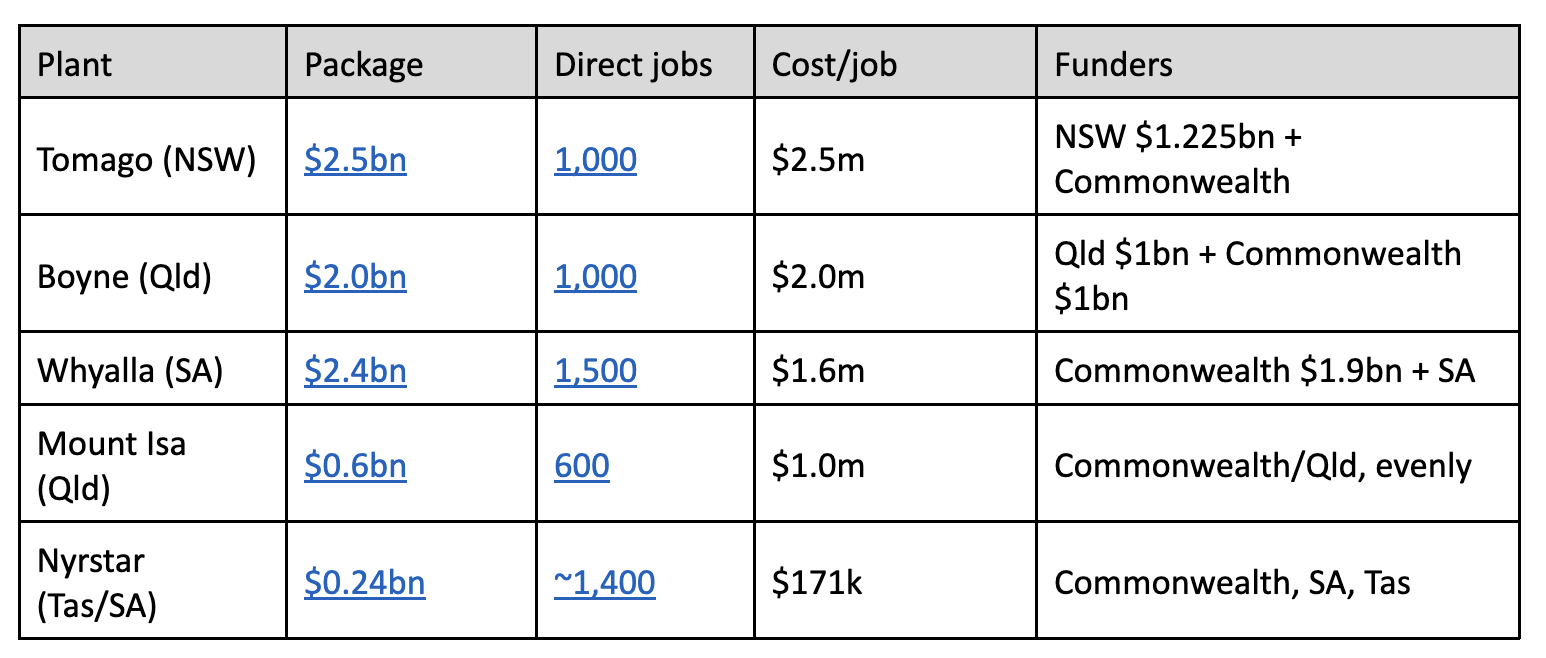
Tomago is the fifth of five rescue packages Australian governments have funded since February 2025, and the second to go directly to a Rio Tinto asset, totalling $7.74 billion and covering an estimated 5,500 direct jobs, an average of $1.4 million per direct job.
The others: Boyne in Gladstone, Qld, also owned by Rio Tinto, announced 24 March 2026, which received a $2.0bn package covering 1,000 direct jobs; Whyalla Steelworks (SA), announced February 2025 after owner GFG Alliance’s collapse into administration, which received a $2.4bn package covering 1,500 direct jobs; Mount Isa (Glencore, Qld), agreed October 2025, up to $0.6bn covering 600 direct jobs; and Nyrstar (Hobart and Port Pirie), $0.24bn across two packages covering roughly 1,400 direct jobs.
A sixth deal remains unresolved: Rio Tinto’s Bell Bay Aluminium in Tasmania is in the same negotiation now. Its power contract expires 31 December 2026, a $60 million-a-year gap remains unresolved.
Of Australia’s four aluminium smelters, three (Tomago, Boyne, Bell Bay) are Rio Tinto’s, and all three have either been bailed out or are mid-negotiation for one.
The fourth, Alcoa’s Portland smelter in Victoria, received none of the $7.74 billion committed since 2025.
Australian households are absorbing energy costs without a rescue package of their own.
Electricity costs rose 37 per cent in the year to February 2026, according to the Australian Bureau of Statistics, though most of that spike is the state and federal energy rebates running out rather than new price rises; strip the rebates out and underlying electricity prices still rose 4.9 per cent, driven by ordinary retailer price reviews in July.
Electricity is now the single largest driver of housing costs in the inflation basket, and housing, up 7.2 per cent annually, is the biggest single contributor to Australia’s overall 3.7 per cent inflation rate.
All about the energy transition
It is the same underlying story as the smelter bailouts, a power system in transition pricing everyone out at once, but households have had rebates that expired, not a $7.74 billion package.
While the deal is undeniably corporate welfare – Rio Tinto has long threatened closure amid with the end of its long term subsidised coal-fired power supply contract, it has been applauded by renewable energy experts as valuable for the energy transition.
“Now Rio Tinto and partners have agreed to invest another $1.1 billion in modernisation and decarbonisation on top of the $2.5 billion state and Federal investment package in renewable energy,” wrote Tim Buckley.
“Rio Tinto has long threatened Tomago closure when the subsidised coal power contract expired end 2028. The world is embracing decarbonisation and Tomago is >95% export focussed, so Rio has long made it clear green aluminium exports was the only international path forward.
“Australian value-added facilities are strategically challenged in the absence of a clear price signal for embodied decarbonisation in international trade … Green aluminium is the only path forward for investment says Rio Tinto.”
This article was first published by Michael West Media