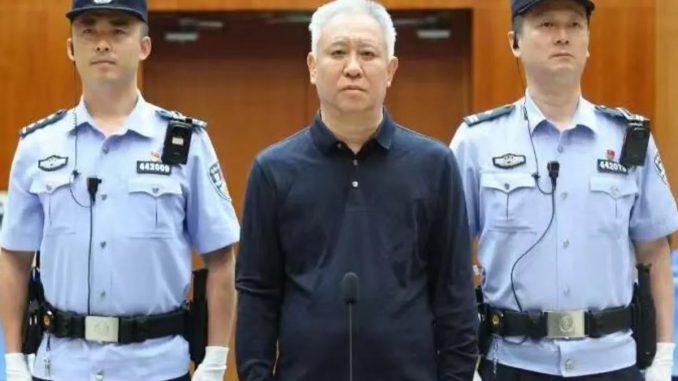
There was a time when Hui Ka Yan appeared to embody everything that China’s extraordinary economic transformation had promised, now his assets have been confiscated and his been handed a sentence of life imprisonment for charges, including embezzlement and corporate bribery.
The son of a rural family in Henan, Hui rose from the steel industry to build Evergrande into one of the largest property empires in the world. He became one of China’s richest men, accumulated a fortune measured in the tens of billions of dollars and cultivated the political and business connections that accompanied his extraordinary rise.
This week, that story ended in a Shenzhen courtroom. Hui, also known as Xu Jiayin, was sentenced to life imprisonment after being convicted of multiple financial crimes connected with the spectacular collapse of China Evergrande. The court ordered the confiscation of all his personal property. Evergrande and its property subsidiary were fined a combined 15.82 billion yuan, or more than US$2 billion.
The sentence is extraordinary even by the standards of China’s crackdown on corporate misconduct. But the significance of Hui’s conviction goes well beyond one disgraced billionaire. It is a judgment on an entire business model.
Evergrande was built on borrowing, rapid expansion, aggressive land acquisition and the relentless sale of apartments before they were completed. At its peak, it was one of the world’s most indebted companies, carrying liabilities of more than US$300 billion.
When the money stopped flowing, the empire began to collapse. The consequences spread far beyond Hui’s shareholders. Homebuyers were left waiting for apartments. Suppliers went unpaid. Investors lost money. Banks and financial institutions were exposed. China’s already fragile property market was pushed deeper into crisis.
Evergrande became the most visible symbol of a property boom that had become dangerously dependent on debt. The Chinese authorities have now made clear who they believe bears responsibility.
The numbers that brought down an empire
The Shenzhen Intermediate People’s Court found that Hui engaged in large-scale financial fraud between 2016 and 2021, including inflating Evergrande’s financial position and concealing liabilities.
Authorities have previously alleged that Evergrande overstated revenue by roughly US$80 billion during 2019 and 2020, using practices including recognising property sales prematurely.
But behind the billions were thousands of individual decisions: apartments sold, deposits paid, loans extended, bonds issued and financial statements relied upon by investors.
The court found Hui guilty of a range of offences, including fundraising fraud, illegally taking public deposits, illegal use of funds, embezzlement and corporate bribery. He had pleaded guilty to eight charges in April.
The empire that became too big to ignore
Evergrande’s spectacular rise was inseparable from China’s property boom. For decades, property development became one of the country’s most powerful engines of economic growth. Developers borrowed heavily, acquired land and presold apartments, generating cash that could be recycled into another round of expansion.
Evergrande expanded from property into electric vehicles, football, tourism and other businesses. At one point, Hui’s personal fortune was estimated at more than US$45 billion.
The company became a corporate giant. But size did not make the underlying business model sustainable. In 2020, Beijing introduced measures designed to curb excessive borrowing by property developers. Evergrande’s access to credit deteriorated rapidly.
In 2021, the company defaulted on its debts. The collapse became one of the defining events of China’s property crisis. Evergrande was eventually ordered into liquidation in Hong Kong in 2024. Its collapse became a warning to investors around the world about the risks of excessive leverage in China’s property sector.
The punishment sends a message
Hui’s life sentence is also a message from Beijing. For years, China’s private-sector entrepreneurs were celebrated as engines of growth. The country’s billionaires became symbols of China’s emergence as an economic superpower.
But the political environment has changed. The state has increasingly emphasised financial stability, regulatory control and what Beijing describes as high-quality development.
The Hui case demonstrates that enormous wealth and political connections provide no permanent protection when authorities decide that financial misconduct has become intolerable.
More than 50 people associated with Evergrande were also sentenced in connection with the case, receiving prison terms ranging from less than two years to 18 years. The corporate penalties were equally severe. Evergrande Group was fined 8.82 billion yuan, while Evergrande Real Estate Group was fined another 7 billion yuan.
But Hui’s conviction doesn’t solve Evergrande’s problem
There is a danger in treating the imprisonment of Hui Ka Yan as the final chapter. Putting the founder of Evergrande behind bars does not restore the fortunes of shareholders who lost money.
It does not automatically compensate the millions of people whose confidence in China’s property market was shattered. It does not erase the company’s enormous debts, nor resolve the structural problems that remain in China’s property sector.
Indeed, Evergrande’s collapse is only one part of a much larger crisis. Other developers have also defaulted. Property prices have fallen sharply in many parts of the country. Household confidence has weakened. Developers have struggled to obtain financing and complete projects.
The fundamental question remains whether China can move from an economic model heavily dependent on property construction and debt-fuelled investment towards one based on sustainable household consumption and productivity.
The international consequences continue
Evergrande’s downfall also remains relevant outside China. Its offshore creditors have spent years attempting to recover money from the wreckage. Liquidators continue to pursue assets and claims in international courts.
Just this month, a Hong Kong court allowed Evergrande’s liquidators to pursue a claim against PwC International concerning alleged auditing failures, a case involving billions of dollars in potential damages. That means the Evergrande story is still being played out in courts around the world. The criminal case against Hui may be over. The financial reckoning is not.
From billionaire to prisoner
Perhaps the most striking aspect of Hui’s downfall is the speed with which the symbols of success were transformed into evidence of excess. The private jets, luxury properties, football investments, political connections and extraordinary personal fortune have disappeared.
What remains is a criminal conviction, a life sentence and the confiscation of his personal assets. Hui’s rise once appeared to demonstrate the limitless possibilities of China’s economic miracle. His downfall demonstrates something rather different. Debt can create extraordinary wealth — until the debt becomes the story.
Evergrande did not collapse because China suddenly stopped building apartments. It collapsed because an expansion model based on borrowing, presales and ever-rising asset values eventually reached its limits.
Hui Ka Yan has now been held criminally responsible for some of the conduct that accompanied that expansion. But the larger question remains unanswered. How many other Evergrandes were built on the same foundations — and what will happen when the next one comes down?